

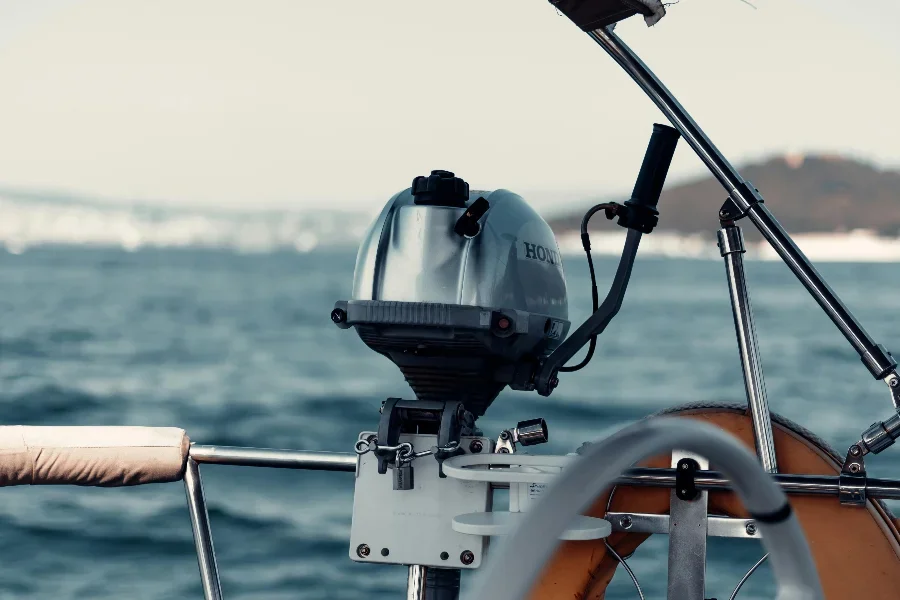
Choosing the Right Portable Outboard Motor: A Complete Guide
Introduction: More Power Isn’t Always the Answer
Choosing a portable outboard motor involves a delicate balancing act. The goal isn’t to find the most powerful motor, but the right motor for your specific boat and how you use it. A motor that’s too big can be dangerous and inefficient, while one that’s too small will leave you underpowered and frustrated.
This guide will walk you through the five critical factors you need to consider to make an informed decision: Horsepower, Weight, Fuel Type, Shaft Length, and Key Features. By the end, you’ll know exactly what to look for.
Factor 1: Horsepower (HP) – Matching Power to Your Boat
Horsepower determines how much weight your motor can push and whether it can get your boat “on plane” (skimming efficiently across the water’s surface).

🖼️ IMAGE: [outboard-horsepower-boat-size-chart-infographic.png]
Alt-text: *Infographic showing recommended outboard horsepower for different boat types: 2-5 HP for dinghies, 5-15 HP for jon boats, 15-30 HP for small fishing boats.*
-
2.5 – 5 HP: Ideal for inflatable dinghies, small sailboats (as an auxiliary kicker), canoes, and kayaks. These provide displacement speed (creating a wake) and are perfect for tender duties or calm-water fishing.
-
5 – 15 HP: The sweet spot for 8-12 ft. inflatables, 10-14 ft. jon boats, and small fiberglass skiffs. This range can often plane a lightly loaded boat, making it much more efficient for covering distance.
-
15 – 30 HP: Best for 12-16 ft. fishing boats, larger inflatables, and utility skiffs. These motors provide confident planing power with two passengers and gear.
Safety First: NEVER exceed your boat’s maximum rated horsepower, which is listed on a plate mounted on the transom. This is a critical safety rule.
Factor 2: Weight – The Portability Factor
If your motor isn’t truly portable, it defeats the purpose. Weight is often the most limiting factor.
🖼️ IMAGE: [person-carrying-portable-outboard-motor.jpg]
Alt-text: A person easily carrying a lightweight 3.5 HP outboard motor by its integrated handle, demonstrating true portability.
-
Under 45 lbs (20 kg): Considered truly portable. Most adults can lift and mount these alone. This category includes motors up to about 6 HP.
-
45 – 80 lbs (20 – 36 kg): “Portable” with effort. These are often 8-15 HP motors. Mounting alone can be challenging, and they are better suited for semi-permanent mounting or use with a lifting davit.
-
Over 80 lbs (36 kg): Not practically portable. Require two people or a hoist for installation and removal.
Pro Tip: If you’ll be frequently taking the motor on and off (e.g., for a dinghy), prioritize a model in the under-45-lb category.
Factor 3: 2-Stroke vs. 4-Stroke – The Great Debate
This is a fundamental choice that impacts convenience, maintenance, and performance.
🖼️ IMAGE: [2-stroke-vs-4-stroke-outboard-comparison.jpg]
Alt-text: *Side-by-side visual comparison of a 2-stroke and 4-stroke outboard motor, highlighting key internal differences.*
| Feature | 2-Stroke Outboard | 4-Stroke Outboard |
|---|---|---|
| Weight | Lighter for the same horsepower | Heavier |
| Fuel | Requires oil/gas mix (e.g., 50:1) | Uses straight gasoline |
| Operation | Simpler, fewer moving parts | More complex, like a car engine |
| Maintenance | No oil changes | Requires periodic oil changes |
| Sound | Louder, higher-pitched “buzz” | Quieter, deeper “purr” |
| Emissions | Higher | Lower (Cleaner) |
| Ideal For | Ultimate portability, simplicity | Quiet operation, frequent use |
Verdict: Choose a 2-stroke if maximum lightness and simplicity are your top priorities. Choose a 4-stroke for quieter, cleaner, and more fuel-efficient operation if you can handle the extra weight.
Factor 4: Shaft Length – Getting the Fit Right
A motor with the wrong shaft length will perform poorly and can be damaged. Measure your boat’s transom height from the top down to the bottom of the hull (the keel).
🖼️ IMAGE: [outboard-shaft-length-measurement-diagram.png]
Alt-text: Diagram showing how to measure a boat’s transom height and match it to the correct outboard motor shaft length (15″, 20″, 25″).
-
15″ Short Shaft: For transoms 15″ – 17″ high. Standard for most small dinghies, inflatables, and jon boats.
-
20″ Long Shaft: For transoms 20″ – 22″ high. Common on larger inflatables, sailboats, and some fishing boats.
-
25″ Extra-Long Shaft: For transoms 25″ and higher. Typically found on offshore boats and large sailboats for heavy weather.
Internal Link: Unsure about your transom? Our How to Measure for an Outboard Motor guide has detailed steps.
Factor 5: Features & Convenience
Small quality-of-life features can make a big difference in your enjoyment.
-
Integrated vs. External Fuel Tank: Motors under 6 HP often have a small integrated tank—great for short trips. Larger portables use a separate external tank, offering longer range but less convenience.
-
Electric Start: Available on some larger portable models (e.g., 9.9 HP). A luxury that eliminates pull-starting.
-
F-N-R Gearing: Most motors have Forward and Neutral. Forward, Neutral, and Reverse is more convenient for docking and maneuvering.
-
Charging Capability: Some models have an alternator to keep a small battery charged for lights or fish finders.
Quick Decision-Making Scenarios
-
For a 10 ft. Inflatable Dinghy: A 3.5-5 HP, 15″ shaft, 2-stroke motor. It’s light, powerful enough, and simple.
-
For a 14 ft. Jon Boat for Fishing: A 9.9-15 HP, 15″ or 20″ shaft, 4-stroke motor. You need the power to plane and the quiet operation not to scare fish.
-
For a Sailboat as a Kicker: A 4-6 HP, long shaft (20-25″), 4-stroke motor. You need the long shaft to stay in the water and the clean, reliable 4-stroke operation.
🖼️ IMAGE: [portable-outboard-motor-use-cases-collage.jpg]
Alt-text: Collage of three images: a dinghy with a small motor, a jon boat with a mid-size motor, and a sailboat with a auxiliary motor.
Conclusion: Your Perfect Motor Awaits
The “right” portable outboard is the one that feels like a natural extension of your boating lifestyle. By carefully weighing horsepower against your boat’s size, prioritizing a manageable weight, choosing between 2-stroke simplicity and 4-stroke refinement, verifying the shaft length, and selecting the features you’ll truly use, you can invest in a motor that provides years of reliable service and fun on the water.
Ready to Browse?
-
View our range of Portable Outboard Motors
-
Explore Lightweight 4-Stroke Motors
External Link: For the most rigorous and independent performance testing, consult the experts at Boating Magazine’s Outboard Reviews.